
Fast Charging Explained: PD, QC, and Wattage – Everything You Need to Know
In today’s fast-paced digital world, a dying smartphone battery can feel like an absolute productivity killer. Fortunately, smartphone manufacturers and accessory brands have made massive leaps in charging technology. Gone are the days of leaving your phone plugged in overnight just to reach 100%. Today, we have fast-charging technologies capable of reviving your phone’s battery from zero to 50% in under half an hour.
However, with great speed comes great confusion. Terms like Power Delivery (PD), Quick Charge (QC), Watts (W), Volts (V), and Amps (A) get thrown around constantly, leaving many consumers wondering what actually works best for their devices.
If you want to understand how modern charging works, how to choose the right charger, and how to optimize your setup for peak SEO performance while providing ultimate value to your readers, this comprehensive, SEO-friendly guide breaks it all down.
Table of Contents
1. The Fundamentals of Charging: Understanding Wattage, Volts, and Amps {#the-fundamentals-of-charging}
To understand fast charging, we first need to look at the basic electrical components that make power flow into your device:
-
Voltage ($V$): Think of voltage as the water pressure pushing electricity through a cable.
-
Current/Amperage ($A$): Think of amperage as the volume or width of the water stream flowing through the pipe.
-
Wattage ($W$): Wattage is the total measure of electrical power. It is calculated by multiplying Voltage by Amperage ($Volts \times Amps = Watts$).
Older standard chargers typically delivered about 5 Watts (5V at 1A). In contrast, modern fast chargers scale up either the voltage, the amperage, or both dynamically to push significantly higher wattage (ranging from 18W all the way up to 240W) into compatible batteries safely.
2. What is USB Power Delivery (USB-PD)? {#what-is-usb-power-delivery}
USB Power Delivery (USB-PD) is the universal charging standard developed by the USB Implementers Forum (USB-IF). It is supported by an overwhelming majority of modern tech giants, including Apple (for iPhones and MacBooks), Google (for Pixel devices), Samsung, Nintendo, and countless Windows laptop manufacturers.
Key Features of USB-PD:
-
Universal Compatibility: A single PD charger can power your smartphone, tablet, wireless earbuds, and laptop, provided it outputs enough wattage.
-
Dynamic Negotiation: USB-PD smart-negotiates power output between the charger and the connected device. Instead of sending maximum power blindly, the devices communicate to find the optimal voltage and amperage profile.
-
USB-C Standard: USB-PD relies entirely on USB-C connections, ensuring reversible plug orientation and massive data transfer speeds alongside rapid power delivery.
-
Programmable Power Supply (PPS): An advanced extension of USB-PD, PPS allows real-time voltage and current adjustments in fine increments (reducing heat generation and improving charging efficiency, especially utilized heavily by Samsung’s Super Fast Charging).
3. What is Qualcomm Quick Charge (QC)? {#what-is-qualcomm-quick-charge}
Developed by chip giant Qualcomm, Quick Charge (QC) is a proprietary fast-charging protocol designed specifically for devices powered by Qualcomm Snapdragon processors (found in many Android smartphones from brands like Motorola, Xiaomi, OnePlus, and older Samsung Galaxy models).
Evolution of Quick Charge:
-
Quick Charge 1.0 & 2.0: Increased voltage steps to deliver higher power output compared to legacy 5W chargers.
-
Quick Charge 3.0 & 4/4+: Introduced Intelligent Negotiation for Optimum Voltage (INOV), allowing fine-grained power regulation to minimize thermal waste.
-
Quick Charge 5: The latest iteration capable of delivering staggering charging speeds exceeding 100W, taking a device from 0% to 50% in just 5 minutes under optimal conditions while staying cooler than previous generations.
Note: Many modern chargers feature “hybrid” support, offering both USB-PD and Quick Charge compatibility in a single charging brick.
4. Other Notable Fast-Charging Protocols {#other-notable-fast-charging-protocols}
While USB-PD and QC dominate the global market, several smartphone manufacturers use proprietary charging protocols to achieve lightning-fast speeds:
-
Apple MagSafe / High-Wattage Lightning/USB-C: iPhones support high-wattage USB-PD (with recent models supporting 20W–30W+ wired charging and 15W+ wireless MagSafe charging).
-
OnePlus / Oppo / Realme (SuperVOOC): These brands push high current (amperage) rather than high voltage into the phone. This keeps the power conversion brick outside the phone (reducing internal device heat) to achieve speeds up to 80W–150W+.
-
Samsung Super Fast Charging: Uses USB-PD PPS (Programmable Power Supply) to deliver 25W, 45W, or higher charging speeds to Galaxy flagships.
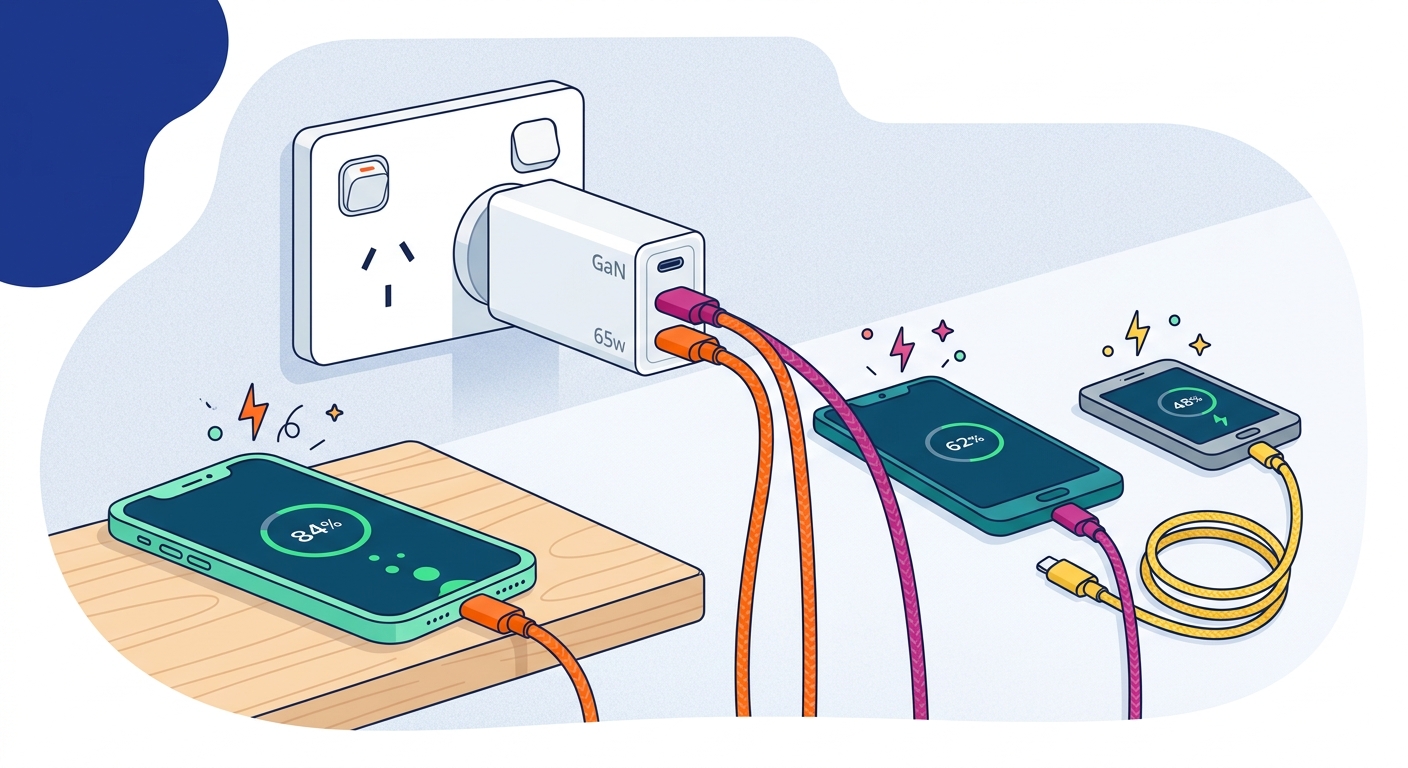
5. The Role of GaN (Gallium Nitride) Technology {#what-is-gan-technology}
If you’ve shopped for a charger recently, you’ve likely seen GaN (Gallium Nitride) advertised heavily. Traditional chargers use silicon semiconductors, which generate significant heat and require bulky transformers and heat sinks.
GaN replaces silicon with Gallium Nitride, a material that can conduct much higher voltages over higher frequencies without overheating.
-
Benefits: GaN chargers are remarkably smaller, lighter, and more energy-efficient than traditional silicon chargers, allowing multi-port 100W+ chargers to fit in the palm of your hand.
6. Does Fast Charging Damage Your Battery? (Debunking Myths) {#does-fast-charging-damage-your-battery}
A common concern among consumers is whether fast charging degrades battery health faster than slow charging.
The short answer: Not significantly, thanks to smart Battery Management Systems (BMS).
Modern smartphones and chargers feature advanced internal microcontrollers that monitor battery temperature, voltage, and state of charge in real-time.
-
Charging is fastest from 0% to 50% when the chemical composition of the lithium-ion battery can absorb energy rapidly without stress.
-
Once the battery reaches around 80%, the charging speed automatically throttles down to a trickle charge to prevent overheating and prolong long-term battery longevity.
While chemical degradation is a natural part of any rechargeable battery’s lifecycle over years of use, modern fast charging protocols are engineered with built-in safeguards to keep wear-and-tear to an absolute minimum.
7. How to Choose the Right Fast Charger {#how-to-choose-the-right-charger}
With so many options available, follow this quick checklist to pick the ideal charger for your ecosystem:
-
Check Your Device Specifications: Look up your phone or laptop’s maximum supported charging wattage (e.g., iPhone 15 Pro supports ~27W max; Samsung Galaxy S24 Ultra supports 45W max).
-
Look for USB-PD and PPS Support: Choosing a charger with USB-PD and PPS ensures maximum compatibility across iPhones, iPads, Androids, and laptops.
-
Invest in Quality Cables: A high-wattage charger is useless if your cable isn’t rated to handle the current. Look for E-Marker certified USB-C cables capable of handling 60W, 100W, or 240W.
-
Opt for Multi-Port GaN Chargers: Buying a multi-port GaN charger allows you to charge your laptop, phone, and tablet simultaneously from a single wall outlet.
8. Conclusion {#conclusion}
Fast charging technology has transformed how we power our daily devices, eliminating battery anxiety and keeping us connected. By understanding the differences between USB-PD, Qualcomm Quick Charge, and Wattage ratings, you can make informed purchasing decisions, protect your battery health, and ensure all your gadgets charge at peak efficiency.